
Trading Expectancy Calculator
Test whether your average winners outweigh your average losers.
Turn win rate and trade outcomes into one comparable edge metric.
- 100% Free
- No Signup
- Runs Locally
Read the result
Expectancy measures the average edge, not the next outcome
A positive result can still include losing streaks. A negative result can still produce occasional winners.
Average losses outweigh average wins at the entered win rate.
The edge is too small to absorb much friction or estimation error.
Average winning contribution exceeds average losing contribution.
The entered sample currently shows positive expectancy before costs not already included.
How it works
1. Enter win rate
Use a real sample of closed trades.
2. Enter averages
Use net average win and loss values.
3. Compare contributions
See whether winners offset losers.
Review the trades behind the expectancy
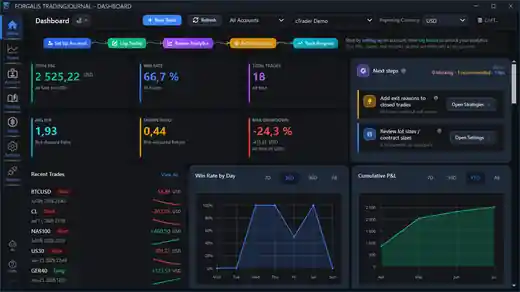
This calculator estimates expectancy from summary inputs.
Forgalis TradingJournal keeps the underlying trade history and structured review fields together so you can filter and inspect the records behind performance.
Transparent calculation
How trading expectancy is calculated
All outputs use the same entered win rate and average closed-trade outcomes.
Win contribution
Win rate × Average win+$112.50 per trade
Loss contribution
Loss rate × Average loss$66.00 per trade
Expectancy
Win contribution − Loss contribution+$46.50 per trade
Projection
Expectancy × Number of trades+$4,650.00
Important: This is a mathematical estimate from historical averages. Include commissions, spread and slippage inside the average win and loss values for a net expectancy result.