
Daily Loss Limit Calculator
Set the session boundary before emotions take over.
Know exactly when the trading day is done.
- 100% Free
- No Signup
- Works Everywhere
How it works
1. Set the daily cap
Define the maximum loss allowed from the start-of-day balance.
2. Add today's P/L
Enter realized and open P/L, including trading costs.
3. Respect the boundary
Reduce risk or stop when the remaining allowance is too small.
Review whether you respected the limit
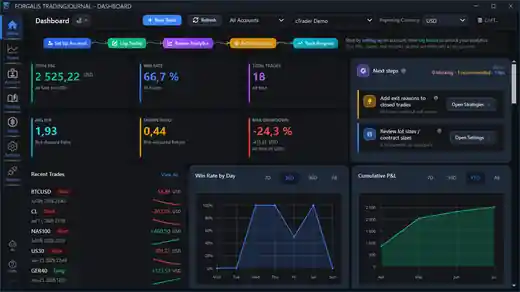
This calculator defines the boundary before or during the session.
Forgalis TradingJournal is a separate Windows app for reviewing whether you stopped, reduced size or kept trading after the limit was reached.
Related Tools
Use it on your website
Embed this calculator with a simple iframe. No signup required.
View embed codeCommon Questions
Should current daily P/L include open trades?
Yes. Open losses, realized P/L, commissions and fees can all move the account toward the daily boundary.
Do profits increase the daily loss allowance?
Not in this calculator. It uses a fixed start-of-day limit, so positive P/L does not encourage more risk later in the session.
What are full-risk losses left?
It is the number of complete planned trade losses that fit inside the remaining daily allowance. Partial capacity is not rounded up.
Does this match every prop-firm rule?
No. Firms can use equity, balance, floating P/L, reset times, trailing limits and different fee rules. Always follow the exact rule that applies to your account.
Transparent calculation
How the daily risk boundary is calculated
The calculator uses a fixed start-of-day balance. Positive P/L does not increase the planned loss allowance.
Maximum daily loss
Starting balance × Daily loss limit %$10,000.00 × 3% = $300.00
Current loss used
max(−Current daily P/L, 0)Current P/L −$100.00 gives $100.00 of used loss capacity.
Remaining daily risk
max(Daily loss limit − Current loss, 0)$300.00 − $100.00 = $200.00
Full-risk losses left
floor(Remaining risk ÷ Risk per trade)$200.00 ÷ $100.00 = 2
Important: This is a conservative personal risk-limit model. Broker and prop-firm rules may use equity, floating P/L, fees, reset times, trailing thresholds or a different reference balance.